Tag Archives: homebrew

Back to Extract Brewing

It’s been a long time since we did our first all-grain batch of homebrew — and never looked back. But we recently moved to New Jersey and bought a very well-preserved mid-century house, which among its many quirks is the fact that all of the kitchen appliances are just a little bit smaller than is standard today. In particular, the clearance over the stovetop is about 20 inches, much too low to have a 18+ inch kettle boiling on it.
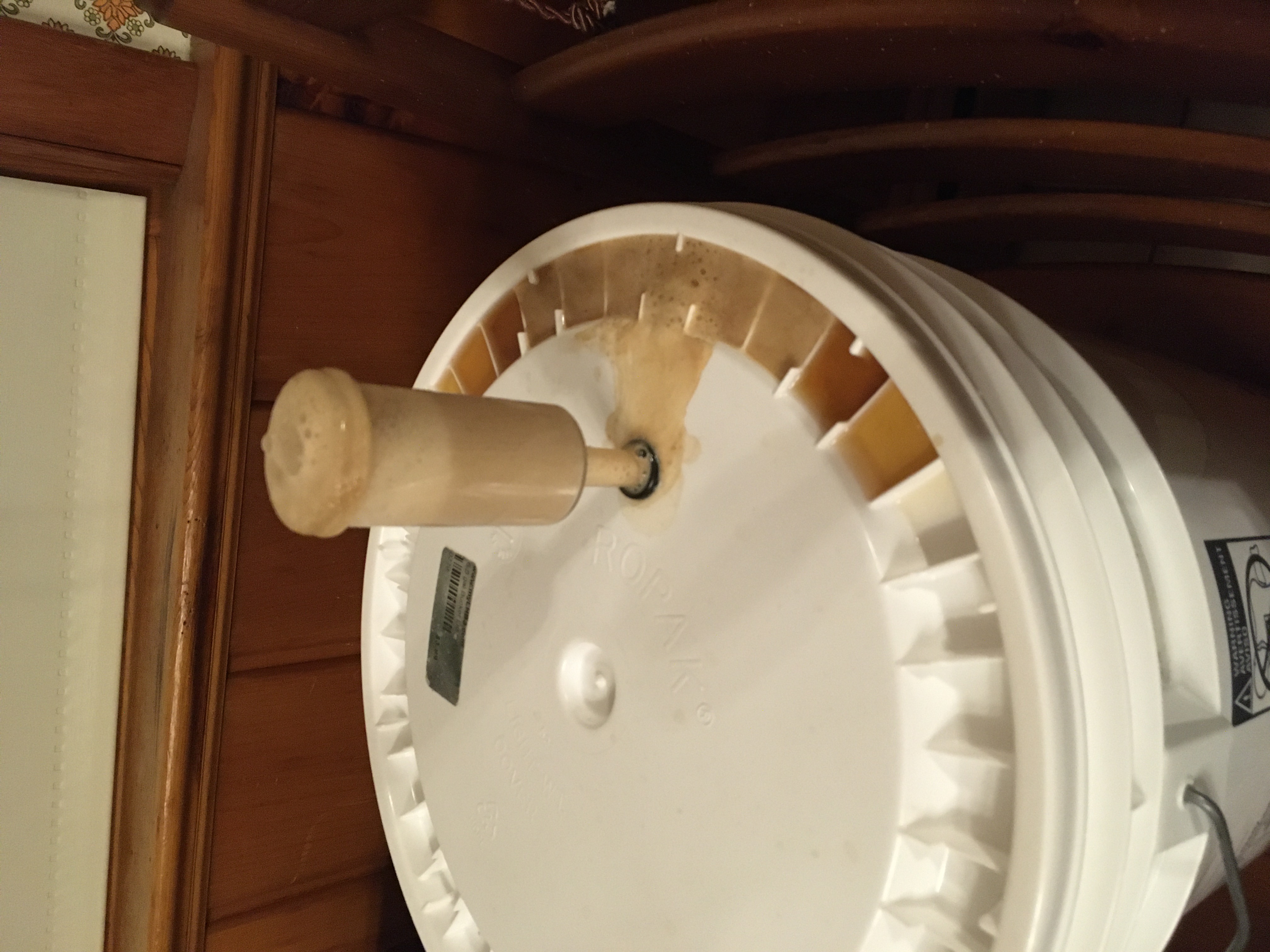
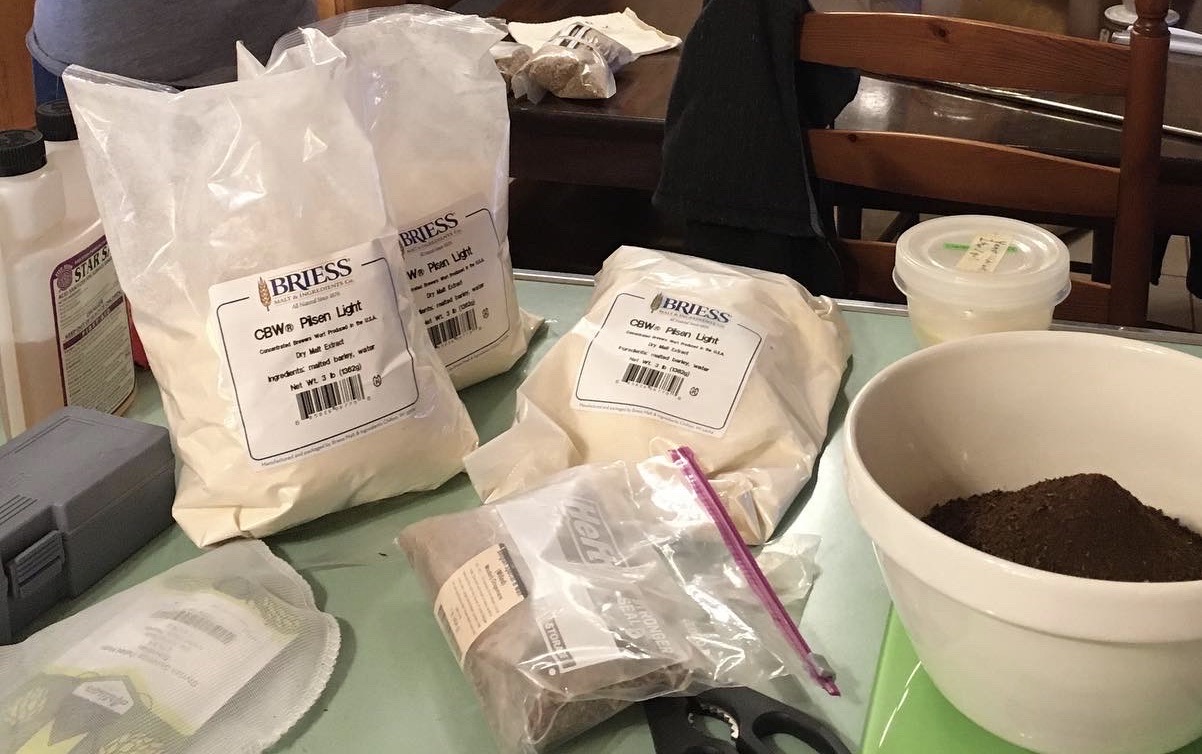
So, we dusted off our book of extract recipes, dug around in our odds-and-ends box of specialty grains, and put together a dubbel using the extract version of the recipe we used for our first all-grain batch 8 years ago. It was a little strange to be measuring malt mostly by ounces instead of pounds, but it was also nice to have the brew be a leisurely afternoon instead of an all-day affair (having much colder groundwater helped cool the brew down much faster too). And the yeast didn’t seem to mind — they went to town and produced a vigorous froth that foamed out the airlock after a couple days.

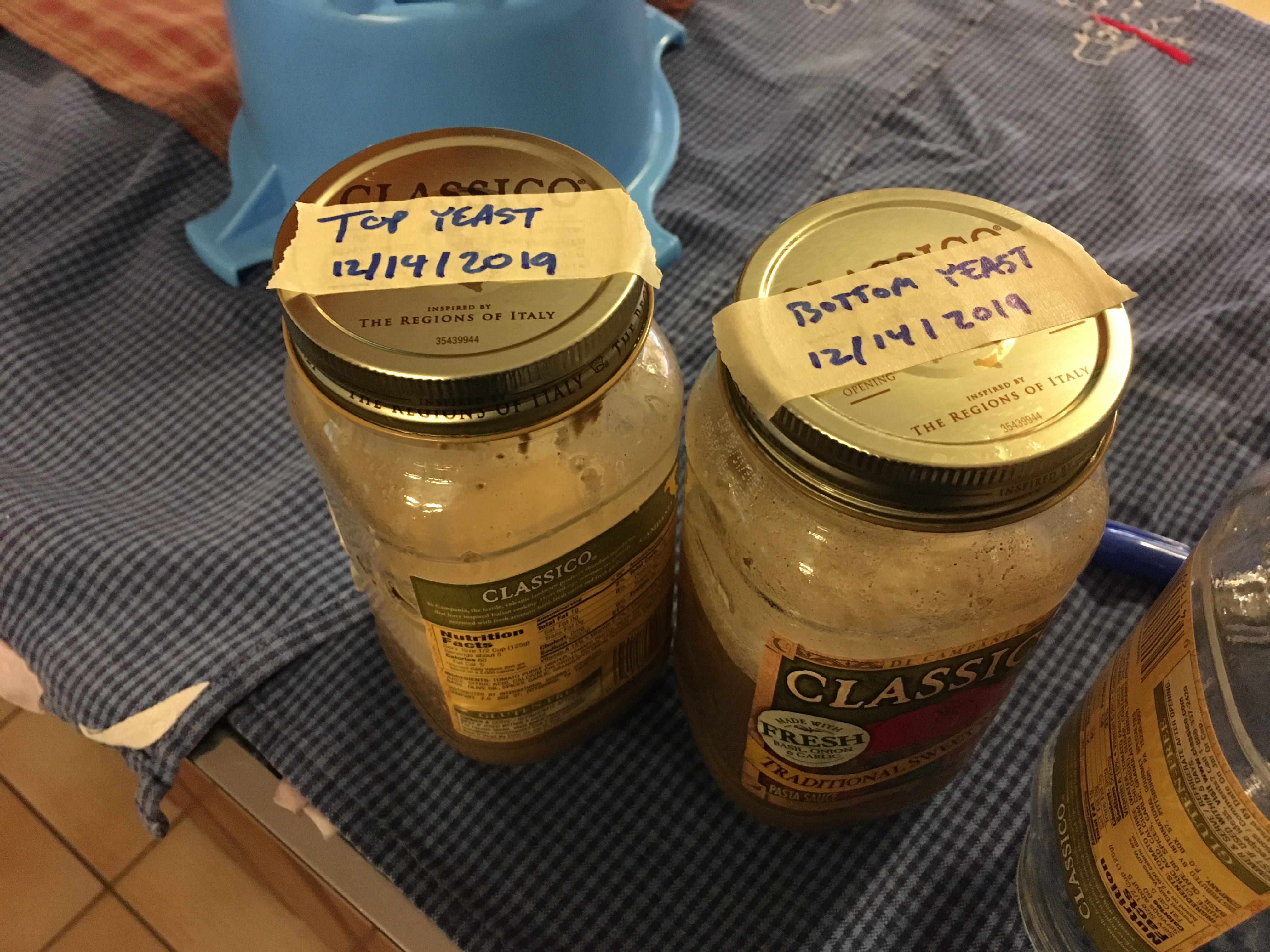
So we siphoned the beer over to a carboy to finish, and harvested that happy yeast for later. We’re planning to brew an extract variant of our colonial stout and blending with some of the last batch that’s been aging in a small oak barrel for far too long.
Colonial Stout

Since it’s been a very hot and muggy summer, we were talking about what we’d like to brew for later in the year when it cools off.  We were fondly remembering the imperial stout we brewed last year, but recognizing that even on a chilly fall evening, we weren’t often in the mood for a 10% beer.

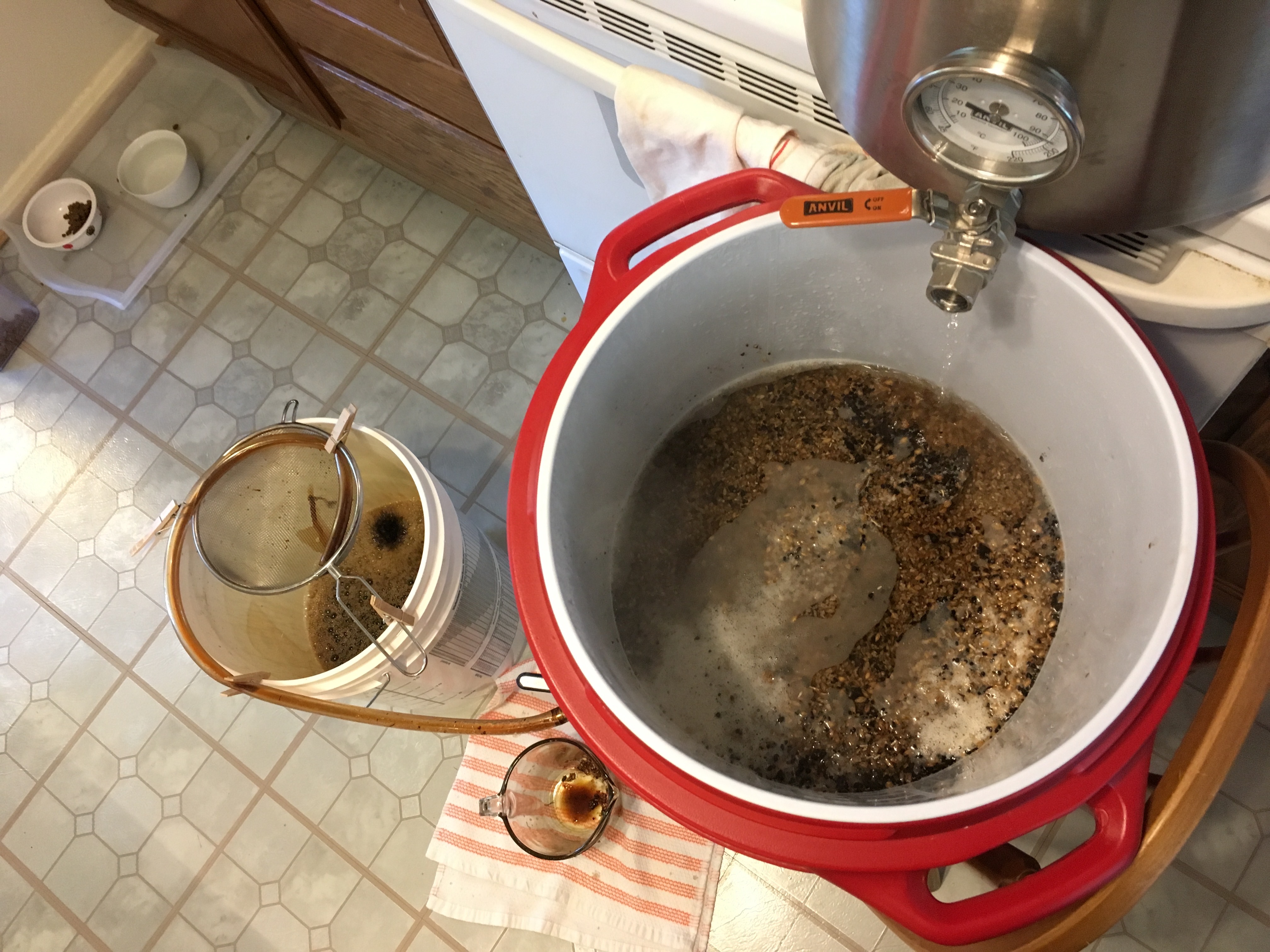
So we thought we’d scale it down a bit, to something more approachable like 6%, but keep the same ratios of grains — a mix of maris otter, mild, chocolate, crystal, special B, etc. that we’re calling Colonial Stout.  It’s in the fermenting bucket now, and cacao nibs are infusing in vodka to be added next week.

Recent Homebrews

We haven’t been blogging, but we have been brewing (and knitting, and sewing, and making soap, and….).

Batch #25 was our first stout, clocking in at 9.5%.  We used a variety of dark malts (crystal, chocolate, “Special B”, smoked, and roasted barley) to get rich flavor we like in stouts, but avoided the darkest malts (like black patent) and only small amounts of some of the darker malts to avoid too much bitterness.  We also had a pound of cacao nibs that we picked up at Lake Champlain Chocolates last summer, which we wanted to infuse.  After some research and dithering (because there are a billion variations on how homebrewers brew with chocolate), we decided to soak them in vodka for a few days and pour the chocolate liquor into the fermentor for second fermentation.

The initial fermentation was explosive.  Fermentation started almost immediately, and fouled the airlock in less than an hour.  I’m glad I put it in the bathtub overnight, because it made a mess in there, blowing the airlock completely out of the neck of the fermentor.  But it quickly settled down.  And the end result is really good — a rich, velvety stout with tons of flavor, but very little bitterness.

Batch #26 was our first wild beer.  We picked up some apples at the farmers market near us, and I’d read that yeast cultured from apple skins was generally good for brewing beer (or cider, obviously).  So I skinned the apple and put the skins in a moderately-strong wort (which had some crystal malt to encourage yeast that could handle that).  It took a few days to begin fermenting, but I was then able to step it up like a normal starter, and then save the yeast for later.

Later turned out to be a few months later, when I brewed with a friend.  I brought the yeast, and he had some malt extract and a big bag of frozen mixed berries.  So we mashed and pasteurized the berries, and added the slurry to the extract wort at the end of the boil, and pitched the wild yeast as soon as it cooled off.

At first, we thought the wild yeast had failed to start, because there was no bubbling activity.  But when we checked it after a week, fermentation was done (and much more efficient than we expected for wild yeast).  The result is like a very dry saison, with some tannin from the berries, and a little fruitiness.

Both of these have been fun to drink, and well-received when we’ve shared them.  So it’s encouraging us to try some new things.

Kettle-Soured Saison

We’ve tried to brew sour beer before, but with little success.  Which is unfortunate, since sours are the main style we like that we can’t easily find in shops.  So we were excited to hear about some alternate methods for souring beers that don’t involve waiting for years for traditional barrel-souring to work its magic.  We read the Mad Fermentationist blog post about a faster souring process,  and then found a really good breakdown of the various souring options.

We decided to go with the sour-kettling technique, which boils down to taking a break between collecting wort and doing the boil to sour the wort with Lactobacillus.  We used the same recipe we usually use for our Saison Bruxellensis, and left the wort in the kettle (bundled up with towels to keep in as much of the heat as possible).

We added pure Lactobacillus culture from White Labs, and let it sour for a few days, watching the pellicle formation and checking the pH with color-change test strips.

This is where we hit our first complication: the pH strips were not nearly sensitive enough to reflect the small changes in pH we were seeing.  So we mostly relied on taste to monitor the souring process.  It was a little hard to judge the sourness, because the unfermented wort has a bunch of sugar in it.  We reasoned that the fermentation would convert the sugar and make it seem more sour, so we stopped when the sourness was noticeable but not dramatic.  As it turns out, the final beer was no more sour, so next time we might let it go a little longer.

We did the boil and fermentation as usual with both saison yeast and Brett Bruxellensis in primary.  The fermentation proceeded normally, the gravity stabilized, and we bottled with priming sugar as usual.  But I think we were too hasty in bottling, because when we opened the first bottle about a week later, it was badly over-carbonated.  Shortly after that, the caps began to swell.  We put as many of the bottles as we could fit in our kegerator, and luckily we haven’t had any bottles explode.

So, there are a few kinks to work out in the process, but overall it seems very manageable.  It does add a few days between the mash and the boil — though that’s probably not a bad thing, since it naturally splits the brew day, and each half fits into an evening instead of taking up an entire day of our weekend.

The final results are very nice, if we do say so ourselves.  A very drinkable sour saison, with a little body, a little funk, and a mild sourness.  It’s not gueuze, but it’s much better than our (basically non-existent) previous sour options.

Tasting of Doom

We were going to bottle a batch of beer, and were running short on 12 oz. bottles.  So we decided to taste all the homebrew we have hanging around (including some of questionable quality), and decide if there were any bottles we could free up — that is, if any of them were so bad we’d never drink them.

We started with our sours — five batches of saison fermented in 1 gallon glass growlers for a year, with various souring agents and a small honeycomb of oak for them to live on:

  • 17a (plain saison): this tasted fine, with more oak than we expected, but was almost completely flat.  Decision: borderline (would drink if we can carbonate it somehow).
  • 17b (Brett. bruxellensis): also fine, with good Brett character, but also terribly undercarbed.  Decision: borderline.
  • 17c (Lactobacillus): terrible and acrid.  Decision: drainpour.
  • 17d (Brett. & Lacto): sweet and cloying.  Decision: drainpour.
  • 17e (White Labs Sour Mix): very nice, but completely flat.  Decision: borderline.

We then moved on to our last batch of cysers/meads — again, small batches fermented in 1 gallon glass growlers, with four different kinds of honey:

  • 16a (Cross Creek Tupelo honey): sweet, rich, and completely flat.  Luckily still mead is a thing (not the thing we were trying to make, but sometimes you have to be flexible).  Decision: keep.
  • 16b (Cross Creek Everglades honey): very nice, but with a little bit of off flavor.  Decision: borderline.
  • 16c (Uncle John wildflower honey): lots of dark honey, oaky.  Decision: keep.
  • 16d (Uncle John’s clover honey): light, with tons of honey character, best of the tasting.  Decision: keep.

I’m left with an appreciation of how hard mead and sour beer are to get right.  Of the two, the mead definitely turned out better, with even the worst batch being tolerable.  By contrast, the sours with Lactobacillus are foul and undrinkable — it was easy to dump those to free up some extra bottles.  But the other sours were fine, other than being flat.  So we’re thinking about trying to force-carbonate them, either by decanting the remaining bottles into a keg, or using our Sodastream.

New Beer Freezer

The old faithful wine beer fridge finally gave up the ghost a couple weeks ago.  It had been reliably chugging along for years, but recently had trouble keeping the temperature down, and was running most of the time.  I did some searching online to try to find a good replacement.  I initially thought that a kegerator without the taps would be the best option, since they are large, don’t have weird bumps in them that eat into bottle storage, and keep very cold efficiently.  But they’re also much more expensive than either wine fridges, or a new category I hadn’t seen before: beverage refrigerators.  The beverage fridges seemed like a good option, since they’re designed for soda/beer (i.e., colder than wine).  But I couldn’t find any good info on how big they were inside, and estimating their capacity based on the number of soda cans made it look like they wouldn’t hold that many bottles (20-30 as opposed to the 35 the old wine fridge held).

2014-12-30 10.28.33But then we found a reasonably priced chest freezer.  Even after buying an external temperature controller (which cuts the power to keep the freezer from getting too cold), it was less expensive than the beverage fridges.  And after I built a little shelf to hold a crate of bottles in a second layer, it can hold quite a bit more than the wine fridge (about 50 bottles).

The other advantage of having a chest freezer is potentially being able to lager or cold crash beers after fermenting (or being able to do a controlled-temperature fermentation if we wanted to).  And if our trusty kegerator stops working, we could always drill a few holes and make the chest freezer into a keezer.

Month-Old Hops

After a month, the three different hop plants are showing very different results:

  • The Golding (middle) is doing very well.  It has two bines trained on its lines and is climbing well.  It’s got healthy leaves and has put out a couple new shoots.
  • The Fuggle (right), is doing OK with a couple of decent shoots starting to train up its lines.
  • The Saaz (left) isn’t doing very well at all, with just a few tiny shoots still too small to train.  The one bine we did train has withered.

I’ve heard that many hop varieties need a year to get established, so the Saaz and Fuggle might just need to wait until next year.  But I’m hopeful the Golding at least will grow well and maybe give us some hops this year.  If the Saaz doesn’t start making progress soon, I think we’ll take one of the other Golding shoots and take over one of the Saaz lines.

Hops Trellised

The hops have already started putting out feelers (especially the Golding which has sent out 5 of them already), so we moved them over to a place with good southern exposure and started a twine trellis for them to climb up the mostly-abandoned backyard play fort.

For the Golding, we got to choose the best two bines and prune off the rest.  The Fuggle only had one decent bine going, so we’ll wait and see if it has another.  The Saaz has a couple of very small shoots, so it should be ready to be trained in a few weeks.

Apparently hops can grow 15 to 20 feet.  We’ve only got 8 feet of fort (really more like 7 feet because of the pots).  But if we’re blessed with the problem of overgrowing bines, I figure we can just let them grow over the top of the fort.

Hops in Florida?

I had always assumed that it was too hot and/or swampy to grow hops in Florida, since they’re typically grown in cooler climes.  But it turns out that quite a few people have tried it (at least at the backyard-hobbyist level) and posted about it online.  So it seems at least vaguely plausible that we can grow them successfully in our backyard, so we figured it was worth giving it shot.

We asked our local garden center about it and they hadn’t heard of anybody growing hops in Gainesville.  But we found a nice online retailer and got a few varieties of hops that we like and use frequently (Fuggle, Goldings, and Saaz).  A few days later, we had a small box with three hop crowns packed in what looks like barley hulls.  We got them potted in nice large pots this morning, and tucked them under an oak tree in our backyard to give them good shade and shelter from the heavier rains, to give them a gentle introduction to the Florida climate.  Once they’re established and putting out bines, we plan to trellis them up (and if necessary, over) our backyard play fort that’s not getting much use lately.  With any luck, our early winter will be roughly like the harvest season in more typical hop-growing places, and we’ll have fresh hops to brew with before Christmas.

The growing conditions are supposed to have a big impact on the aroma and flavor, so we’ll have to wait and see how they turn out.  But we figured going with hops we like was a good starting point.  There are a dizzying number of hop varieties, and a lot of new ones coming out all the time.  So if these three don’t work out, we might try again with a few different varieties before we give up hope.

Speaking of Sours…

We brewed a batch of saison in September and split it into five 1-gallon batches two months ago.  One batch was plain, one batch had Brett. Bruxellensis, one batch had Lactobacillus, one batch had both, and the fifth batch had White Labs’ sour mix.

I’m trying to be patient, and I’ve read that it often takes six months or more for the Brett. and Lacto. to work their magic.  But it has been two months, so we took some samples today to see how they’re going.  The first three batches were a little disappointing: they weren’t sour at all and had a definite sweet note, despite having attenuated pretty well (SG 1.014, 6.5%).  The fourth batch (Brett & Lacto) was lacking the sweet note and was just a tiny bit of tangy.  The fifth batch (White Labs’ mix) was decidedly sour.

So that’s promising.  We’ll park the growlers back in the pantry and check back in another few months, and try to be patient…